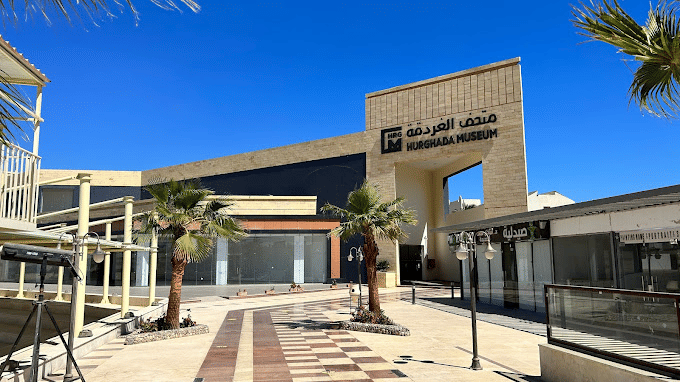

Hurghada Museum | A Journey Through Egypt's Rich History
History of Hurghada Museum

The Hurghada Museum was inaugurated in 2020 and is the first antiquities museum of the Red Sea Governorate. The museum also was the first collaborative effort between the Ministry of Tourism and Antiquities, the Red Sea Governorate, and the private sector. The attraction has been designed to showcase the beauty and luxury of Egypt in history through themed exhibition halls. Each of the five permanent exhibitions in the museum depicts an era of Egyptian history through artefacts and simulated halls.
Famous as one of the newest antiquities museums in Egypt, the Hurghada Museum covers a collection of 3,000 artefacts from different periods. You can learn the history of each period, ranging from prehistory to modern Egypt, as part of the guided tours organised here. The museum adds a historical dimension to the beachfront beauty of Hurghada and narrates the city’s history as well.
Exhibitions at Hurghada Museum

The first exhibition of Hurghada Museum is themed around Ancient Egypt which began from early humans and lasted up to 332 BCE. The artefacts belong to prehistoric settlements, the Pharaonic kingdoms, the Egyptian civilisation, and the Greco-Roman era in Egypt. The exhibition simulates a Pharaonic cemetery full of coffins, mummies, and mountainous tombs to showcase the spirit of ancient Egypt.

The Greco-Roman period in Egyptian history lasted from 332 BCE to 641 CE and was a period of incredible cultural synthesis. Alexander’s rapid expansion led to the fall of Egypt in 332 BCE, while Roman Emperor Augustus took over in 30 BCE. The next centuries saw the Roman Empire (27 BCE to 395 CE) and the Byzantine Empire up to 641 CE.

An informal name for the period from the third to seventh centuries CE, the Coptic Period encompassed the Late Roman and Byzantine eras. What made this period stand out were the religious shifts in Egyptian cultural traditions from ancient Egyptian religion towards Coptic Christianity. The period practically ended with the arrival of Islam in the seventh century.

The Islamic conquest of Egypt in 639 BCE marked the beginning of a golden age where economy, culture, and science flourished. This was a general period of prosperity that began under the Abbasid caliphs who ruled large parts of the Middle East from Baghdad. Scholars mark the end of this period with the collapse of the Abbasid caliphate and the 1258 CE Siege of Baghdad.

The final exhibition of the Hurghada Museum focuses on the developments in Egypt after the Napoleonic invasion of Egypt in 1798. The subsequent rise of Muhammad Ali Pasha in the early 19th century meant a step towards Egypt’s modernisation. As Muhammad Ali’s dynasty gained independence from the Ottomans, the prestige and power of Egypt grew manifold until the 20th century.
FAQ’s
Why is the Hurghada Museum so famous?
The Hurghada Museum is famous for its themed exhibitions that showcase over 3,000 artefacts belonging to different periods of Egyptian history. The five exhibitions focus on the chronological narration of history from early humans to the modern period in Egypt. The emphasis on Egypt’s beauty and luxury is what makes the Hurghada Museum unique.
What is the famous museum in Egypt called?
Egypt has many museums that are famous worldwide for their massive collections depicting Egyptian history. Apart from the Hurghada Museum, other popular museums include the under-construction Grand Egyptian Museum and the massive Museum of Egyptian Antiquities. Cairo’s Museum of Egyptian Antiquities has the world’s largest collection of Egyptian artefacts and the oldest collection of Pharaonic art.
Is the Grand Egyptian Museum fully open?
No, the Grand Egyptian Museum is not fully open to the public yet as the construction is in progress. However, if you wish to visit, limited trial visits are organised to some of the completed areas of the museum. Get advance reservations and enjoy a tour of one of Egypt’s most hyped museums here.
What kind of artefacts can we see in the museum?
In the Hurghada Museum, you will come across over 3,000 artefacts from different periods of Egyptian history in themed exhibition halls. The artefacts include objects of everyday use, sculptures, statues, mummies, gold objects, and royal collectables. You can also see ancient Egyptian cosmetics, jewellery, furniture, and other exhibits depicting life in Egypt.
When is the Hurghada Museum open?
The Hurghada Museum is open daily from 10 AM to 1 PM and again from 5 PM to 10 PM. Get your tickets online to skip the lines at the ticket counters and enjoy a leisurely visit to the museum.